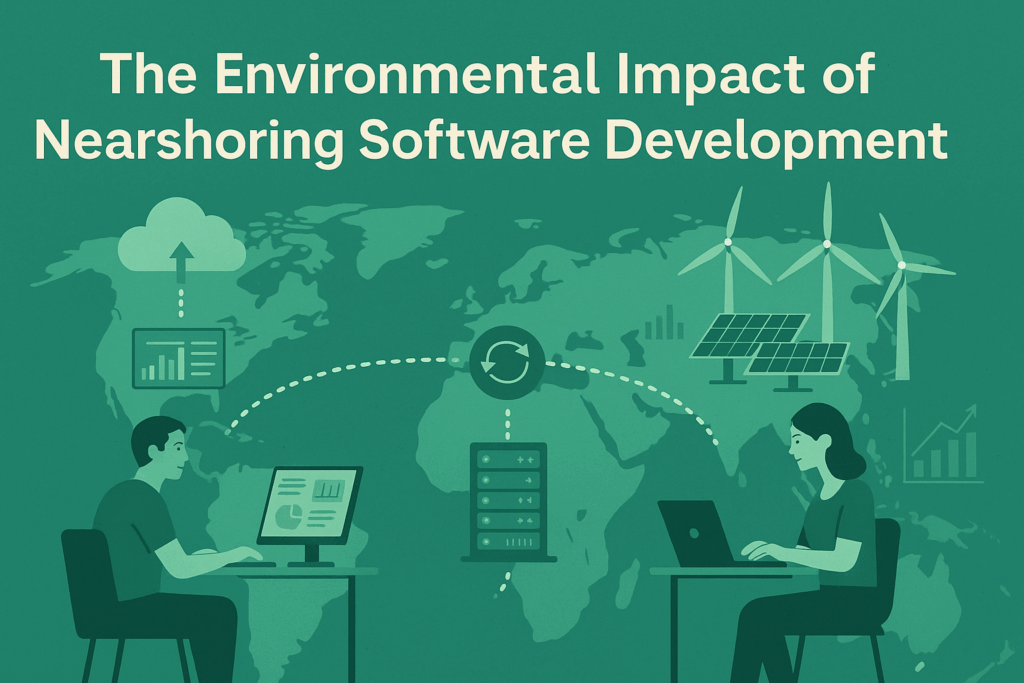
Sustainability in software development is no longer a “nice-to-have”; it is a strategic imperative for any business investing in nearshoring software development. Every line of code consumes energy somewhere, and the environmental impact of nearshoring every collaboration call, sprint review, or deployment adds a tiny but real environmental impact. When you multiply this across global teams, the environmental footprint of software development quickly becomes a serious part of a company’s overall carbon footprint.
Today, the ICT sector is estimated to account for roughly 2–4% of global greenhouse gas emissions, a share that is comparable to the airline industry. This means choices about nearshoring software development, cloud infrastructure, and collaboration models are directly linked to a company’s environmental impact and sustainability strategy. Instead of treating IT as an invisible, clean service, organizations must see nearshoring software development as a powerful lever to reduce emissions and support broader ESG goals.
From Code Quality to Planet Quality
For years, engineering teams focused almost exclusively on code quality, performance, and cost, often ignoring the environmental impact of how and where software is built. Nearshoring software development brings the opportunity to align technical excellence with environmental responsibility by encouraging better architecture, shorter communication paths, and smarter infrastructure decisions. When you improve code quality and process efficiency in a nearshoring model, you also often reduce wasted compute time and unnecessary data transfers, which lowers the overall carbon footprint.
Think of it this way: traditional optimization looked at “How fast can we ship this feature?”, while sustainable nearshoring software development expands the question to “How fast can we ship this feature with the smallest environmental impact possible?”. This subtle mindset shift encourages teams to design leaner applications, select greener vendors, and leverage time zone alignment to reduce overtime, rework, and avoidable computation.
What Is Nearshoring Software Development?
Nearshoring software development is the practice of outsourcing software projects or development teams to neighboring or nearby countries, typically within a similar time zone and cultural context. Unlike offshoring, which may involve working with teams on the other side of the world, nearshoring software development keeps physical and temporal distance relatively small. This model is popular in regions like Western Europe partnering with Eastern Europe, or North American companies working with Latin American development centers.
Because nearshoring software development emphasizes geographic and time zone proximity, it naturally influences travel patterns, collaboration styles, and infrastructure choices. These differences directly shape the environmental impact of software development, making nearshoring a promising alternative for businesses seeking both operational efficiency and lower emissions.
Nearshoring vs Offshoring vs Onshoring
Onshoring keeps software development in the same country, often in-house, which can simplify control but may increase costs. Offshoring sends software development to distant regions with larger time zone gaps, often driving more complex communication, longer flights, and potentially higher environmental impact. Nearshoring software development positions itself in the middle, balancing cost optimization with physical proximity and smoother real-time collaboration.
From an environmental perspective, nearshoring software development often reduces long-haul flights, minimizes the need for frequent in-person visits, and lowers the overhead of miscommunication and rework. While onshoring might still be the lowest-risk option for some organizations, nearshoring software development offers a compelling mix of sustainability, cost-effectiveness, and access to skilled talent with less climate impact than many offshoring models.
Typical Nearshore Software Development Scenarios
Common scenarios for nearshoring software development include building dedicated development centers, creating mixed squads with onshore and nearshore engineers, or partnering with specialized nearshore vendors. In each scenario, teams rely heavily on digital collaboration tools, cloud environments, and continuous integration pipelines. Because of time zone proximity, daily standups, pair programming, and cross-team design sessions become more efficient and less energy-intensive than when coordinating across multiple continents.
These nearshoring software development setups often translate into fewer overnight calls, fewer duplicated efforts, and less wasted computation. When fewer misunderstandings occur, fewer test environments are spun up for rework, and fewer manual interventions are required, the environmental impact of software development drops quietly in the background, supporting the company’s sustainability targets.
The Global ICT Carbon Footprint in Context
To understand the environmental impact of nearshoring software development, you need to look at where emissions come from in the digital world. The main contributors are data centers running cloud services, network infrastructure connecting users and developers, and the devices used by teams. Each of these layers consumes electricity, and the environmental impact depends heavily on the energy mix of the region—clean, renewable energy drastically reduces the carbon footprint compared to fossil-based grids.
Business travel and commuting also play a key role in the environmental impact of software work. Traditional global delivery models often involved regular on-site visits, fly-in fly-out workshops, and frequent alignment meetings. By contrast, nearshoring software development can strategically minimize long-haul travel while preserving the benefits of face-to-face collaboration when it truly matters. This shift is crucial because air travel is among the most carbon-intensive activities in the professional services ecosystem.
How Nearshoring Reduces the Environmental Impact of Software Development
Nearshoring software development can significantly decrease the environmental impact by shortening travel distances and cutting the frequency of energy-intensive flights. When your nearshore development partner is a two- or three-hour flight away instead of a 12-hour long-haul trip, the carbon footprint of necessary in-person meetings drops dramatically. For collaboration that can remain virtual, similar time zones reduce the need for late-night calls and extra hardware running after hours.
Time zone proximity in nearshoring software development also helps teams run more synchronous communication during regular working hours. This synchronicity reduces the need for repeated clarifications, duplicated tests, and additional trial-and-error cycles that would otherwise consume more electricity and compute resources. As a result, nearshoring software development quietly turns process efficiency into environmental efficiency, cutting both wasted time and wasted energy.
Shorter Flights and Lower Travel Emissions
One of the most tangible environmental benefits of nearshoring software development is the reduction in aviation-related emissions. Long-haul flights generate substantially more CO₂ per passenger than short-haul alternatives, especially when trips are repeated several times a year for project kickoffs, steering committees, or escalation meetings. By placing the development center closer to headquarters, nearshoring software development reduces the distance traveled and encourages fewer but more purposeful visits.
Furthermore, nearshoring software development can encourage hybrid collaboration models in which many formerly in-person workshops move online without sacrificing quality. Because stakeholders share overlapping work hours, virtual design sprints, remote backlog grooming, and online retrospectives become natural. Every meeting that stays online instead of requiring a flight translates into a direct reduction in the environmental impact of software development projects.
Time Zone Proximity and Leaner Communication
When teams are scattered across extreme time zones, communication often becomes fragmented and inefficient, which is bad for productivity and bad for the environment. Emails bounce around, asynchronous chats stretch decision cycles, and multiple environments are kept running just to wait for approvals. Nearshoring software development addresses this by aligning working hours, enabling more real-time alignment and faster decision-making.
Because developers, product owners, and stakeholders can talk in real time, nearshoring software development typically results in fewer misunderstandings, fewer unnecessary iterations, and fewer redundant builds. Each avoided rebuild or discarded test run means less server time, less energy usage, and a smaller carbon footprint. Just as lean manufacturing reduces physical waste, lean communication in nearshoring software development reduces digital waste and its environmental impact.
Hidden Environmental Costs of Nearshoring Software Development
Nearshoring software development is not automatically green; it still carries environmental costs that organizations must manage thoughtfully. Data center locations matter greatly: if your nearshore partner relies on cloud regions powered mainly by coal or gas, the environmental gains from reduced travel may be partially offset by a higher carbon intensity of computing. As a result, you should evaluate the energy mix behind your nearshoring software development infrastructure and select providers committed to renewable energy.
Office space and commuting patterns for nearshore teams also contribute to environmental impact. Large offices with inefficient heating and cooling systems, or daily car commutes for every developer, can increase emissions associated with nearshoring software development. Encouraging remote or hybrid work, promoting public transportation, and choosing energy-efficient buildings can significantly reduce these hidden environmental costs.
Comparing Nearshoring and Offshoring from a Sustainability Perspective
When comparing nearshoring and offshoring software development, it helps to think in terms of lifecycle emissions per project. Offshoring might appear cheaper financially, but if it requires frequent long-haul travel, extensive rework due to misalignment, and repeated handoffs across time zones, the environmental impact can be considerably higher. Nearshoring software development, by reducing travel distance and improving communication, often achieves a lower lifecycle carbon footprint for the same business outcome.
Over the lifetime of a product—from initial ideation to long-term maintenance—nearshoring software development can support more stable, trusted relationships that require fewer emergency visits and escalations. When teams understand each other better culturally and linguistically, they tend to build more robust solutions, generate less technical debt, and avoid wasteful “throwaway” experiments. All of this translates into fewer unused environments, fewer redundant test cycles, and lower environmental impact overall.
Green-by-Design: Embedding Sustainability into Nearshore Software Projects
The real power of nearshoring software development emerges when sustainability is built into the project from day one. Green-by-design thinking encourages architects and developers to consider energy efficiency, resource usage, and carbon impact alongside performance and security. Nearshore teams can select cloud regions with high renewable energy penetration, choose right-sized virtual machines, and adopt autoscaling policies that avoid running idle compute resources.
Clean coding practices also play a vital role in environmentally responsible nearshoring software development. Efficient algorithms, minimized data transfers, and optimized database queries reduce CPU cycles and storage requirements, directly lowering energy consumption. When nearshore DevOps teams integrate performance and efficiency checks into CI/CD pipelines, the software becomes greener with every release, amplifying the environmental benefits of the nearshoring model.
Practical Strategies to Make Nearshoring More Sustainable
To truly maximize the environmental benefits, organizations should adopt clear sustainability guidelines for nearshoring software development. Vendor selection criteria can include ISO 14001 environmental certifications, transparency on energy sources, and commitments to carbon neutrality. By preferring nearshore partners that share your sustainability values, you transform nearshoring software development from a cost tactic into a key pillar of your ESG strategy.
Measuring emissions is another crucial step for sustainable nearshoring software development. Companies can track travel emissions for onsite visits, estimate cloud-related emissions using cloud-provider tools, and calculate office-related emissions via building energy data. With this information, organizations can set reduction targets, redesign collaboration patterns, and justify investments in greener infrastructure and remote-first policies that further shrink the environmental impact of nearshoring software development.
Business Advantages of Environmentally Responsible Nearshoring
Environmentally responsible nearshoring software development is not just about doing the right thing for the planet; it also delivers concrete business advantages. Customers, investors, and regulators increasingly scrutinize the environmental impact of digital operations and service providers. Companies that can show a credible, data-backed story about sustainable nearshoring software development gain a competitive edge in RFPs and strategic partnerships.
Talent attraction is another benefit of sustainable nearshoring software development. Many developers, especially younger generations, care deeply about climate change and prefer to work for organizations that take environmental responsibility seriously. When you can demonstrate that your nearshoring software development strategy aligns with strong ESG commitments, you build a more compelling employer brand and increase your ability to retain top engineering talent.
Real-World and Hypothetical Scenarios
Imagine a company that previously offshored software development across an eight-hour time difference and required four long-haul trips per year for workshops and alignment. By switching to nearshoring software development with a three-hour time difference, the company cuts each trip’s emissions and reduces their frequency by half, while improving collaboration. The net effect is a tangible reduction in environmental impact alongside faster delivery and higher-quality releases.
In another scenario, a business already using nearshoring software development decides to optimize for sustainability by moving workloads to greener cloud regions and enforcing remote-first collaboration. They introduce strict guidelines for travel, prioritizing virtual workshops and allowing only critical in-person visits. Over time, this organization sees its emissions per release drop, while productivity and satisfaction in nearshore teams rise—showing that nearshoring software development can be both greener and more effective.
Future Trends: AI, Automation, and Green Regulations
The future of nearshoring software development will be shaped by AI, automation, and emerging environmental regulations. AI-assisted tools can help developers write more efficient code, identify energy-heavy functions, and recommend greener architectural patterns. As these tools are adopted by nearshore teams, the environmental impact of nearshoring software development is likely to decrease further, even as software complexity continues to grow.
At the same time, regulators and industry bodies are moving toward stricter disclosure requirements for carbon emissions and energy usage. Companies will face growing pressure to account for the environmental impact of their global delivery models, including nearshoring software development. Organizations that have already embraced sustainable nearshoring practices will be better prepared to comply with these rules and to showcase their green credentials to the market.
Conclusion
Nearshoring software development offers a powerful opportunity to align business performance with environmental responsibility. By reducing long-distance travel, improving time zone alignment, and encouraging more efficient collaboration, nearshoring software development can significantly lower the carbon footprint of digital projects. When combined with green-by-design architecture, efficient coding practices, and careful vendor selection, nearshoring becomes not just a cost strategy, but a central element of a sustainable IT strategy.
Ultimately, the environmental impact of nearshoring software development depends on the choices organizations make about infrastructure, processes, and partnerships. Companies that treat sustainability as a first-class requirement in nearshore projects stand to gain better performance, stronger brands, and deeper trust from stakeholders. In a world where every watt and every ton of CO₂ counts, nearshoring software development can be a smart, future-ready way to build software that not only works well—but also respects the planet.
FAQs
1. How does nearshoring software development reduce carbon emissions?
Nearshoring software development reduces carbon emissions mainly by cutting long-haul business travel and shortening the distance between teams. With nearshoring, companies often replace intercontinental flights with fewer and shorter regional trips, and they rely more on virtual collaboration within overlapping time zones. This combination significantly lowers the environmental impact of meetings, workshops, and project governance.
2. Is nearshoring always greener than offshoring?
Nearshoring software development is usually greener than offshoring, but not automatically. The true environmental impact depends on factors such as travel frequency, infrastructure efficiency, and the energy mix in cloud regions and office locations. If a nearshore partner uses highly carbon-intensive electricity or requires frequent commuting to inefficient offices, some of the environmental benefits can be reduced, so organizations must evaluate the full picture.
3. What role does cloud infrastructure play in sustainable nearshoring?
Cloud infrastructure plays a central role in the environmental impact of nearshoring software development because most build, test, and deployment activities happen in data centers. Choosing cloud regions powered by renewable energy, right-sizing compute resources, and using autoscaling strategies all help reduce the energy consumption of software systems. Nearshore DevOps teams can also use cloud provider tools to estimate emissions and optimize architectures for greater energy efficiency.
4. How can companies measure the environmental impact of nearshoring?
Companies can measure the environmental impact of nearshoring software development by tracking several data points: travel-related emissions for onsite visits, estimated cloud emissions using provider calculators, office energy consumption for nearshore locations, and commuting patterns of local staff. By combining these metrics, organizations can establish baselines, set reduction targets, and evaluate how process improvements or infrastructure changes affect their overall carbon footprint.
5. What practical steps can make our nearshoring strategy more sustainable?
To make a nearshoring software development strategy more sustainable, organizations can adopt remote-first collaboration policies, limit non-essential travel, and choose nearshore vendors with strong environmental credentials. They can also prefer cloud regions with high renewable energy usage, enforce efficient coding and architecture guidelines, and include sustainability KPIs in vendor contracts. Over time, these steps turn nearshoring software development into a key driver of both operational excellence and environmental performance.
Read More :